
Chattanooga City Directory Collections
Chattanooga Public Library’s Local History & Genealogy Department is the core Chattanooga local shelf. Its Chattanooga House History Guide identifies the local volumes from 1871 through 2008. The Chattanooga local set, the branch-access digital run, and the single 1904 Hill City volume have different endpoints, so each should be named precisely in Chattanooga research notes. Before 1938, the Chattanooga volumes are on microfilm. Chattanooga Library staff can point visitors toward a source or provide scans and photocopies from non-circulating material at rates supplied on request, but the department does not undertake open-ended research.
| Collection | Years | Where held | Access |
|---|---|---|---|
| CPL directory volumes, various publishers | 1871-2008; gaps in 1873-75, 1877, and 1879 | Chattanooga Public Library Local History | Chattanooga Library print and microfilm; pre-1938 on microfilm |
| U.S. directory run at CPL | 1871-1960 | Ancestry Library Edition at CPL branches | Free at every Chattanooga branch |
| Hill City digital volume | 1904 | CPL Digital Collections | Digitized online item |
| Chattanooga Obituary Index | 1873-present | Chattanooga CPL catalog and Open Data Portal | Name, date, and newspaper locator |
The usable Chattanooga historical shelf is broader than directories. Chattanooga Local History also holds newspapers, county-record microfilm, maps, plats, manuscript collections, clipping files, and church-history material. That makes one downtown visit useful when a directory entry needs a second source.
Publisher names should be taken from the title page of the edition being cited. The Chattanooga Library describes the full run as various publishers. Research sources identify Parham for 1871, Ochs & Harris for 1878-79, and Young & Co. for 1906. Those are edition-level references, not evidence of a single publisher across the whole Chattanooga series.
Chattanooga Directory Books Online and On Shelf
The Chattanooga digitized run stops in 1960, while the Chattanooga library’s local holdings continue to 2008. Do not treat a missing online result as a missing book. Visit a Chattanooga Public Library branch for Ancestry Library Edition, then ask Local History about the later Chattanooga shelves or microfilm. The digitized 1904 volume is a useful date-specific starting point, especially when a nearby locality or a related address appears in family papers.
Chattanooga Public Library Local History & Genealogy shows the department that keeps these research materials and reference routes.
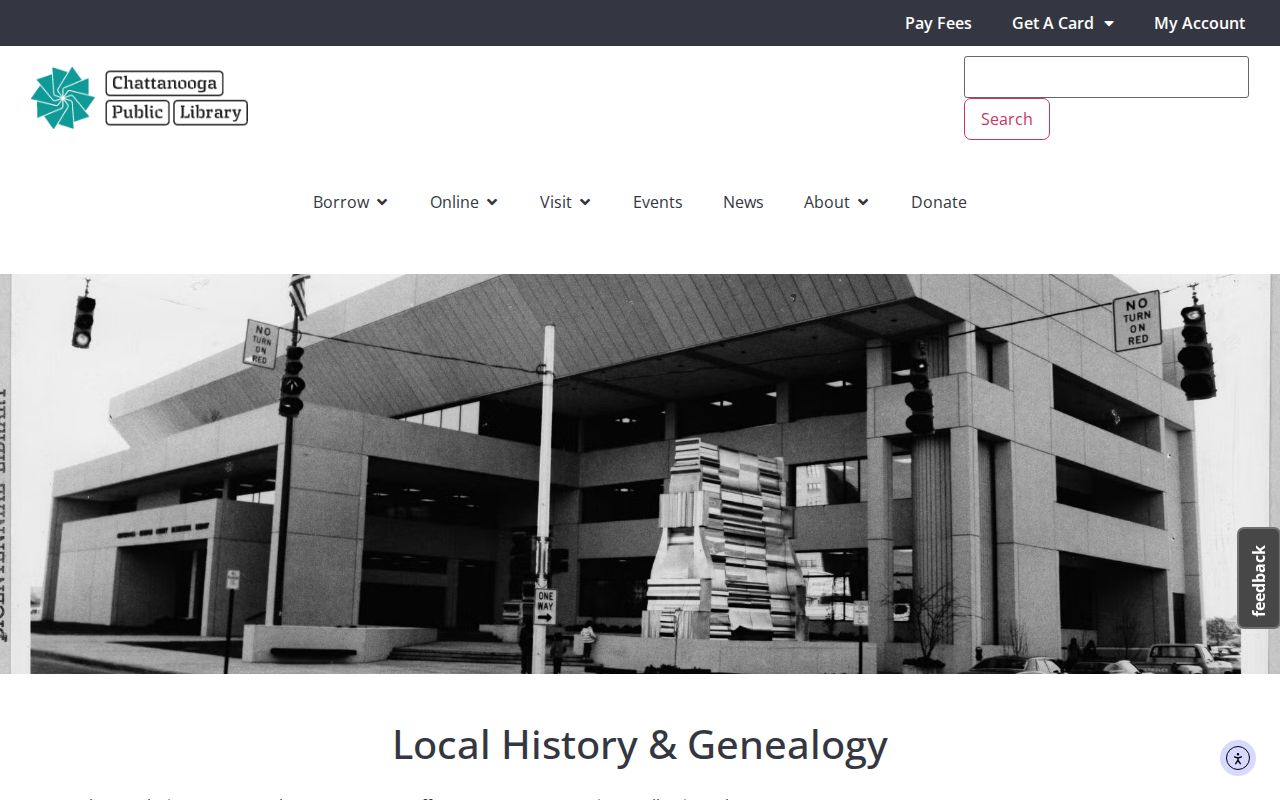
The Chattanooga department’s collections combine directory volumes with newspapers, maps, and manuscript sources, so a dated listing can be checked instead of copied without context.
Note: A digitized index and a physical volume can cover different years, so record the edition year and the access route used.
The Chattanooga Local History & Genealogy Department is at 1001 Broad Street in Chattanooga. Its reference phone is 423-643-7725 and its email is localhistory@lib.chattanooga.gov. Chattanooga staff can identify sources and offer reproductions from non-circulating material, although it does not perform in-depth research for patrons. Bring a precise name, street, date range, or directory year to make the request practical.
Reading a Chattanooga City Directory Entry
A Chattanooga directory entry must be read from the edition in hand. The Chattanooga Library guide verifies that directories can identify prior residents, occupations, and other details, but it does not publish one universal entry layout. A listing may give a name and address, then add an occupation or a relationship marker. The title page and abbreviation key decide what a mark means in that particular year. Copy the entry exactly, including initials, street suffixes, and abbreviations.
| Name | Use the printed spelling and initials as the directory gives them. |
|---|---|
| Address | A listed street number connects a person to that edition’s address, not to every person at the location. |
| Occupation | Some editions include an occupation or work description. |
| Relationship marker | Read any spouse or widow notation only after checking that volume’s key. |
| Ownership notation | Use a symbol only when the edition itself explains it. |
- Criss-cross directory
- A street-ordered section, when a volume includes one, that helps move from an address toward listed names.
- Householder index
- An arrangement that points to a named household rather than every person connected with a street.
- Abbreviation key
- The legend in that edition that explains shortened words and symbols; photograph or transcribe it before interpreting a line.
Later evidence can confirm an identity. For a modern parcel or address-keyed record, use the Chattanooga street directory workflow rather than assuming the historical entry is current.
Chattanooga Directory Gaps Need Bridges
The documented breaks are 1873 through 1875, 1877, and 1879. A blank year is therefore a collection fact, not proof that a household left Chattanooga. Start with the nearest edition on each side. Next test a dated Chattanooga newspaper, a deed or other recorded party, and the released federal census. Keep old spellings and locality labels in the search notes because a change in abbreviation can look like a disappearance.
The Chattanooga Obituary Index helps at the end of a household trail. It supplies a name, publication date, and newspaper, not obituary text. The original Chattanooga newspaper microfilm is held in Local History, and copies can be requested from the department for a fee. In 2025, Chattanooga CPL added an Open Data Portal route while retaining a simplified catalog version, both updated annually.
Note: The obituary index locates a newspaper issue; it does not replace the source microfilm or establish a complete family relationship.
Newspaper microfilm includes the Chattanooga Times, Chattanooga News-Free Press, and Chattanooga Times Free Press from the nineteenth century into the present. The Tennessee Electronic Library route carries Chattanooga Times coverage from 1869 to 1963 through Newspapers.com Southeast Edition. Use a directory year or obituary date before opening microfilm, because those reels are not keyword searchable.
Chattanooga Directories Meet Maps and Papers
A Chattanooga directory tells who was listed at a place in a given edition. Chattanooga maps and Chattanooga collection papers answer different questions. Chattanooga CPL’s House History Guide points to plats dated 1889, 1904, 1914, and 1928, plus Sanborn holdings. The Library of Congress also has Chattanooga Sanborn sets from 1885, 1889, 1901, 1917, 1929, 1931, 1951, and 1955. A sheet can show a structure or use, but its date does not prove who occupied it.
The Chattanooga House History Guide also identifies the mid-1970s Hamilton County Architectural Survey Records, Acc. 352, for qualifying older buildings. Forms and black-and-white Polaroids can add a Chattanooga physical-history layer after the city directory establishes a date.
The Chattanooga House History Guide documents the directory, map, and survey research routes used for a historical Chattanooga address.
The Chattanooga guide helps connect a dated directory listing to physical-site sources without treating any one map or survey record as proof of occupancy.
Note: Check whether a Sanborn sheet actually covers the street before using it to describe a Chattanooga address.
Chattanooga Historical Society Papers
The printed volumes sit beside a wider civic record. The Chattanooga Area Historical Association was chartered in 1948, and CPL holds Chattanooga Historical Society papers from 1861 to 1906. The open finding aid describes bylaws, correspondence, historical addresses, clippings, and related records. Staff performs copying and scanning. These papers provide local context where a directory supplies only a name and street.
The Historical Society papers finding aid identifies the collection and its access status.
A Chattanooga finding aid is a map to a collection, not a searchable resident roll, so ask staff about a dated subject, organization, address, or person already supported by a directory entry.
UTC Chattanooga Special Collections adds another historical route. Its holdings include manuscripts, family papers, business records, photographs, and University Archives. Since March 1, 2025, UTC and CPL direct researchers away from the retired PastPerfect Online database and toward UTC Finding Aids, UTC Digital Collections, CPL Local History Digital Collections, or archivist help. A changed discovery route does not mean the underlying collection disappeared.
Chattanooga Directories After Annexation
Chattanooga’s 1929 annexation of St. Elmo, Missionary Ridge, Alton Park, North Chattanooga, Brainerd, and Riverview doubled the city’s size. Earlier sources can therefore use a locality label that differs from a modern Chattanooga mailing identity. Search the historic community name as well as the present street name. Keep that label in the research log instead of forcing every result under today’s city wording.
Chattanooga’s record history is also spread among separate custodians. Directories and neighborhood context belong at Chattanooga Public Library; recorded instruments remain with the Hamilton County Register of Deeds; assessment details belong with Chattanooga’s Assessor. One Chattanooga collection cannot settle all of those questions, and each source should retain its own date and citation.
Trace a Chattanooga Directory Household
Follow a household across editions rather than reading one directory as a final answer. A person can move, be omitted, appear under initials, or be described differently by another publisher. The strongest trail ties an exact directory wording to a time window and then tests another dated source.
- Begin with a confirmed Chattanooga street name and number in an edition close to the known date. Save the exact line and the title-page information.
- Move one or two editions backward and forward, allowing for the documented gaps and spelling drift.
- Use the street or criss-cross portion only when that particular volume includes one, then note adjacent listed addresses without assuming household relationships.
- Pair each ten-year span with the released federal census and with a Chattanooga property or deed record when available.
- For a disappearance, check the obituary index, newspapers, probate or court routes, marriage index, and recorded transfers.
The 1904 digitized volume offers an example year for careful comparison with surrounding library volumes.
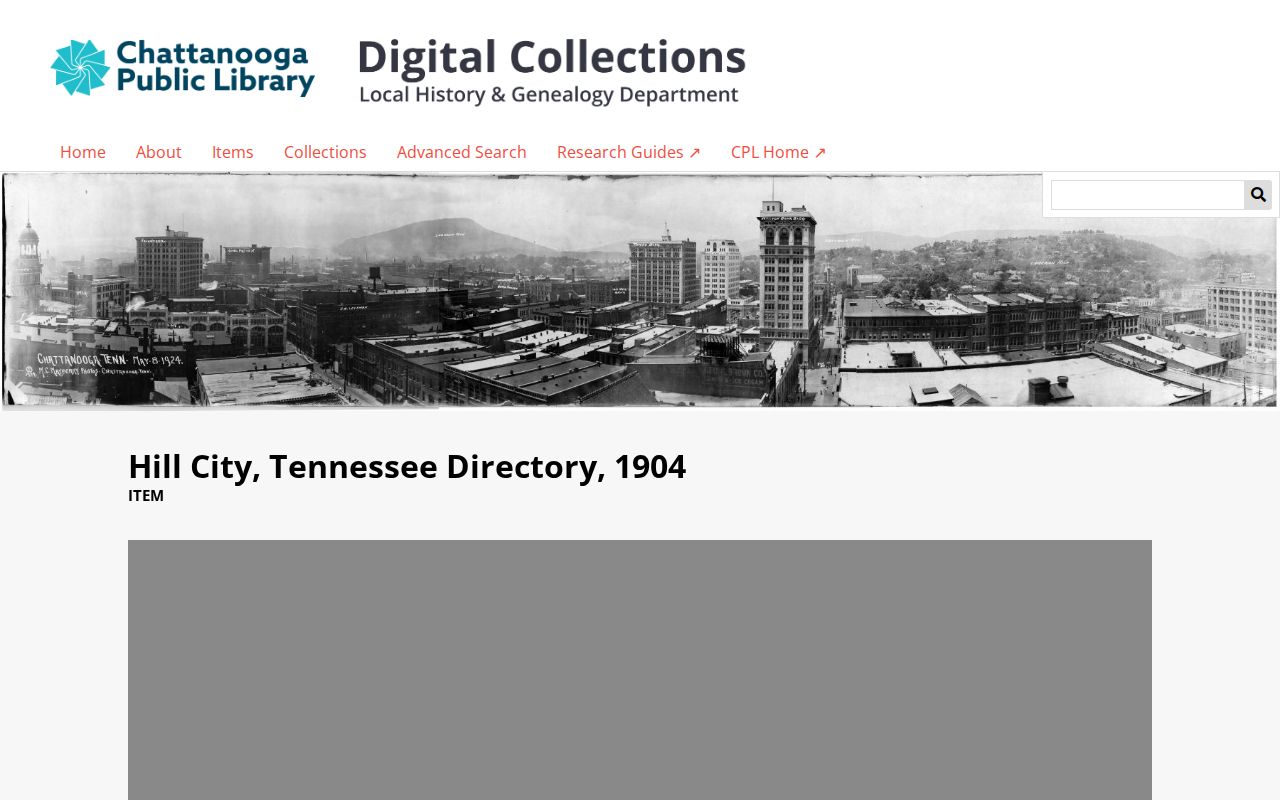
Use a scanned page to preserve what that edition printed, then compare it with nearby years rather than filling a gap with an unsupported conclusion.