
Chattanooga Previous Residents by Era
Different sources answer different parts of a Chattanooga address history. A deed records parties to an instrument, while a Chattanooga directory can list a person at a street in a particular edition. Neither alone proves every occupant or every family relationship. Chattanooga’s Hamilton County record trail is centered on the Chattanooga Assessor, Chattanooga Trustee, and Chattanooga Register. Chattanooga Public Library carries the long historical layer. Use the Chattanooga source that fits the year in question, then compare it with another record.
| Source | Years it covers | Where held | What it shows |
|---|---|---|---|
| Chattanooga Register party search | Required default range begins July 1, 1969 to present | Chattanooga Register account, counter, or microfilm route | Recorded-party, book/page, and document pathway |
| Chattanooga Register microfilm records | Exact earlier years not verified | Chattanooga Hamilton County Register counter or request | Documents marked SEE MICROFILM |
| Chattanooga city directories | 1871-2008; gaps in 1873-75, 1877, and 1879 | Chattanooga CPL Local History | Listed person and address in one edition |
| Chattanooga branch-access directories | 1871-1960 | Ancestry Library Edition at Chattanooga CPL branches | Digitized directory run |
| Federal census and Chattanooga newspapers | Census follows a 72-year release cycle; newspapers span local holdings | Approved archival access and Chattanooga CPL | Dated household or address context |
Begin with the Chattanooga Assessor’s free street, number, parcel, or owner search to anchor the current property record. It is not a list of everyone at the Chattanooga address. That distinction is essential when tracing Chattanooga past residents.
The Chattanooga Assessor accepts one complete search field and can be searched by Street Name, Street Number, Parcel, or Owner. Owner input is last name then first name in one field, and partial surname text can expand a result. A later-listed joint owner may not appear in that owner index because records are indexed under the first named deed owner. For a broader Chattanooga historical inquiry, save the parcel identifier rather than relying only on a surname.
Normalize a Chattanooga Address First
Write down the street number, directional prefix, suffix, and the city or community designation shown by the Chattanooga Assessor. The Chattanooga Assessor warns that street text can match containing names, so a loose street query can bring back more than one road. Save the current Chattanooga parcel or map group before trying variations. The legal description and parcel often survive when street formatting changes.
Chattanooga’s 1929 annexation of St. Elmo, Missionary Ridge, Alton Park, North Chattanooga, Brainerd, and Riverview doubled the city’s size. A pre-annexation directory or newspaper may use one of those locality names instead of a modern Chattanooga label. Keep both forms in the address log. That simple step prevents an old result from being overlooked or wrongly treated as a different place.
Note: A postal city label, an older community name, and a current city jurisdiction can describe the same street differently across time.
Chattanooga Previous Residents and Deed Chains
The deed chain traces recorded ownership, not an automatic list of past residents. From a Chattanooga Assessor or Chattanooga Trustee result, retain the parcel, map group, current owner, and the difference between situs and mailing address. If sales information provides book and page, take it to the Chattanooga Register’s Book & Page search. Otherwise, the Chattanooga Register documents Property, Party, Party/Property, Index, Document, and Quick modes for account holders.
- Record the current Chattanooga property details and any sale reference from the Chattanooga Assessor or Chattanooga Trustee.
- Find the current owner’s acquisition document through a book/page reference or an available Chattanooga Register search mode.
- Record the seller, the recorded date, document type, book/page, and legal description.
- Use the seller as the next party to research, narrowing the date span as the Chattanooga Register instructions require.
- Repeat backward, preserving each link and moving to Chattanooga counter or microfilm access when the electronic trail stops.
- Grantor
- The party conveying an interest in a recorded instrument, commonly the seller in a deed.
- Grantee
- The party receiving the recorded interest, commonly the buyer in a deed.
- Chain of title
- A sequence of recorded conveyances used to study property interests over time.
- Legal description
- The lot, block, subdivision, or other recorded land description that is often steadier than an old street address.
Chattanooga Previous Residents Beyond the Login
Chattanooga’s Hamilton County Register online database is not a free anonymous index. Chattanooga electronic access requires an application and a $50 monthly account fee. Its party search requires a date range and defaults to July 1, 1969 through the present. That is the Chattanooga web workflow’s default, not a claim that the county’s records start then. The Chattanooga Register’s Quick Search uses Chattanooga Assessor sales information to begin a recorded chain, but the office does not perform title searches or guarantee a complete title history.
The Chattanooga Register search login shows the account-access route for property and recorded-document research.
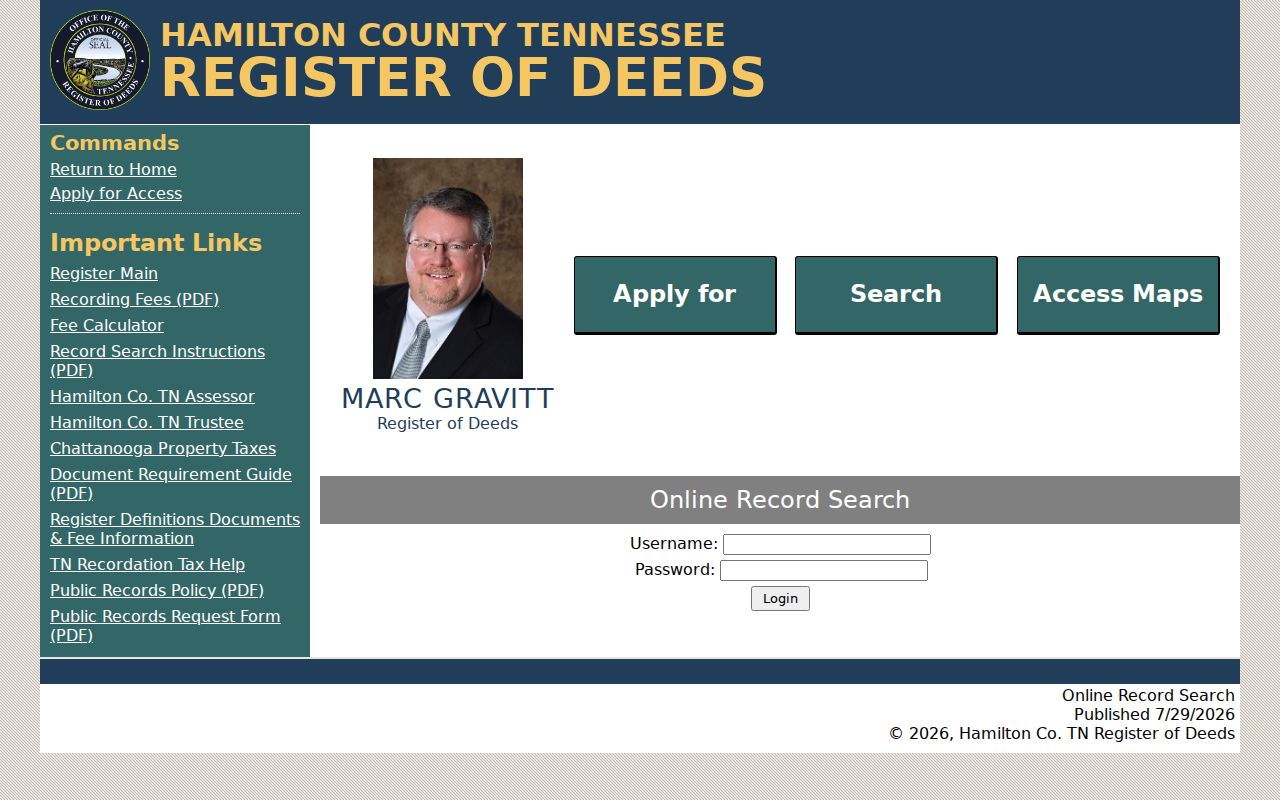
The Chattanooga login screen is a practical reminder to plan for the counter, a focused request, or microfilm rather than assuming every historic image is openly searchable online.
When the Chattanooga Register instructions say “SEE MICROFILM,” the document is not electronic. Inspect it at the Chattanooga Register, request the needed copy, or ask the Chattanooga counter how to reach the cited roll. The Chattanooga office says ordinary open records can also be addressed by phone, email, mail, or a sufficiently detailed Tennessee Public Records Act request. Its counter is at 625 Georgia Avenue, Room 400, Chattanooga, with weekday hours of 8:00 a.m. to 4:00 p.m.
Chattanooga Register instructions describe a linked book/page result and PDF or TIFF image options under Options for account holders. They also state that personal electronic devices may not be used to capture or extract records at the Chattanooga office. Preserve book/page, image choice, and access date in the Chattanooga trail. The Chattanooga Register disclaims conducting a title search, so use the sequence as research evidence and seek appropriate professional advice for a formal title question.
Chattanooga Previous Residents in Directory Years
Chattanooga city directories fill intervals between recorded conveyances. The Chattanooga Library’s run reaches from 1871 to 2008, with known gaps in 1873-75, 1877, and 1879. Pre-1938 Chattanooga editions are microfilm. A directory can establish that a listed adult appeared at a Chattanooga address in that specific edition, but it cannot settle ownership or every household relationship. The collection details and how to read each edition are available on the Chattanooga city directory page.
Pair a confirmed Chattanooga directory year with the released federal census for that decade. Then use Chattanooga newspapers, the obituary index, probate, or a deed transfer to explain a disappearance. For the missing Chattanooga directory years, compare the nearest editions first. A blank in one book can result from a publication gap, a change in street spelling, a changed locality label, or a person not being listed.
The Chattanooga Obituary Index gives a source date and newspaper rather than a text transcription. That makes it a strong endpoint locator after a directory or deed sequence, but the underlying Chattanooga newspaper microfilm remains the record to inspect. A date-specific request for a copy can be made through the Chattanooga Library’s Local History department.
Process: address and parcel → deed parties and legal description → date-specific directory listing → released census or newspaper → obituary, probate, or later conveyance.
Chattanooga House History Sources
Chattanooga past residents and the physical history of a structure are separate questions. Chattanooga Public Library’s House History Guide points researchers to Chattanooga directories, newspapers, searchable photographs, plats, historic-neighborhood files, and the Chattanooga Hamilton County Architectural Survey Records, Acc. 352. The mid-1970s survey includes forms and black-and-white Polaroids for surveyed buildings that met its age threshold. These Chattanooga sources can date a building feature or capture its historic description; they do not establish an occupant by themselves.
The Chattanooga House History Guide sets out the Chattanooga Library’s local research routes.
The Chattanooga guide keeps physical-history evidence distinct from the person-and-address evidence found in a dated directory or recorded instrument.
Chattanooga Previous Residents and Map Dates
Chattanooga Sanborn maps and plats add a map layer to a past-residents trail. Chattanooga CPL’s guide lists plats from 1889, 1904, 1914, and 1928 and Chattanooga local Sanborn holdings for 1901 and 1931 volumes 2-5. The Library of Congress provides Chattanooga sets dated 1885, 1889, 1901, 1917, 1929, 1931, 1951, and 1955. The publicly described 1917 item was republished in 1955 and has 99 sheets.
Check sheet coverage before attaching a map fact to an address. A map may show footprint, use, or a physical change, but it does not name a resident. For later project or compliance materials, Chattanooga’s City Open Records Center can receive an address- and date-specific request when no online display is available.
Chattanooga Past Households and Endpoints
Chattanooga obituaries, newspapers, and probate can close a household trail, but each has its own limits. The Chattanooga Obituary Index covers 1873 to the present and provides the name, publication date, and newspaper. It is a locator, not the obituary itself. Chattanooga Local History retains source microfilm, and its staff can advise on copying options. Before 2025, spouse or partner information in the Chattanooga index was recorded only for women, so its absence should not be overread.
Chattanooga Hamilton County Property Alert is different from historic research. It is a voluntary, non-retroactive Chattanooga alert for later documents indexed under a person, organization, or address. Each alternate spelling requires its own signup, and Chattanooga addresses do not appear on every document.
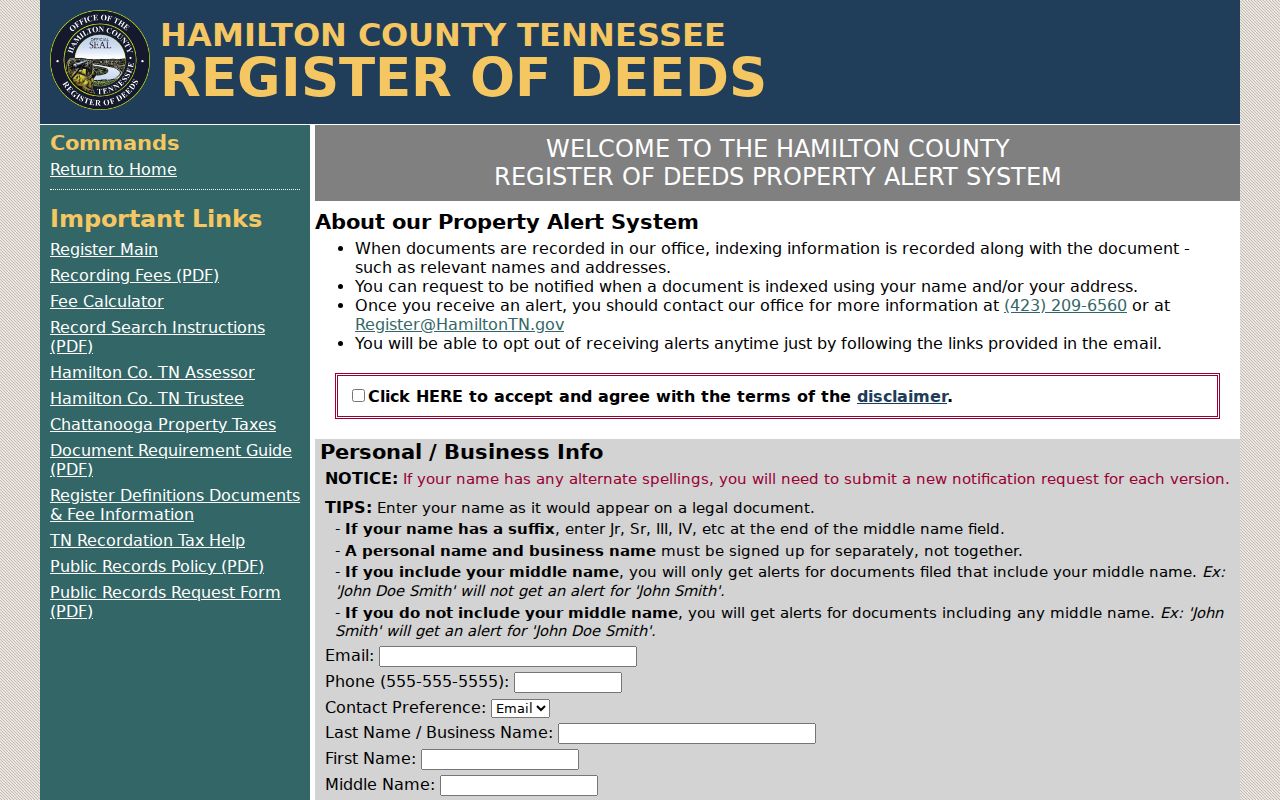
The Chattanooga alert can monitor later indexing but cannot reconstruct a prior deed chain or replace document review.
Lawful use. Chattanooga address history is appropriate for family history, estate questions, and learning about a place. Do not use a past-residents trail to stalk, harass, threaten, or track a living person.