
Chattanooga Resident Lookup Records
No Chattanooga office keeps a complete roster of everyone at every address. Instead, each Chattanooga record documents a particular public connection. The Hamilton County Assessor ties an owner name to an assessed Chattanooga parcel. The Trustee adds tax and mailing fields for Chattanooga parcels. The Hamilton County Register in Chattanooga records parties to instruments, while the Chattanooga Public Library preserves historical listings. Use the Chattanooga source that matches the question rather than trying to make one result prove more than it can.
| Record | What it can confirm | Local route | Access limit |
|---|---|---|---|
| Chattanooga assessment record | Owner name, parcel, situs and assessed-property details | Hamilton County Assessor search | Free; owner is not necessarily an occupant. |
| Chattanooga tax record | Owner names, property address, mailing address and tax context | Trustee Property Tax Inquiry | A mailing address is only a correspondence field. |
| Chattanooga recorded instrument | A named party's documented property connection | Hamilton County Register of Deeds | Online account or counter/request route may be needed. |
| Chattanooga marriage index | A county license entry matching names, date, or officiant | Hamilton County marriage search | Online coverage is 1857 through August 3, 2021. |
| Obituary locator | A newspaper publication date and title for a named person | Chattanooga Obituary Index | The index is not the obituary text. |
For a current Chattanooga property question, begin with the Assessor and compare the parcel with the Trustee record. For a past Chattanooga person, use an edition-specific library directory or obituary citation. A Chattanooga court or certificate question belongs with the relevant clerk or state office. This Chattanooga method keeps ownership, recorded-party status, historical listings, and court activity separate.
Chattanooga Lookup Needs Two Anchors
A Chattanooga same-name hit is not identification. Hamilton County's Chattanooga records are especially useful when two independent details agree. Pair a Chattanooga parcel with a situs address, a deed book and page with a party name, or a Chattanooga court case number with a filing date and party role. The Chattanooga Assessor cautions that a joint owner may be indexed only under the first deed owner, so a failed owner-name search is not a final answer.
Keep a Chattanooga record log: exact spelling used, portal or counter, search date, identifier, and what the source actually says. Do not convert a Chattanooga tax mailing address into a residence claim. Do not merge several weak name matches into a biography. Where the Chattanooga historical trail matters, a dated Chattanooga city-directory entry and a newspaper or released census reference are stronger together than either one alone.
Chattanooga Court Lookup Routes
Chattanooga court systems are split by court and case type. Tennessee CaseFinder is the Hamilton County route serving Chattanooga for Circuit Court and General Sessions Civil inquiries. Its documented choices include Party Name, File Date, and Attorney Name. It is not a Chattanooga search across City Court, Criminal Court, Chancery, Juvenile, or federal cases. The Hamilton County Circuit Clerk in Chattanooga and the Sessions Civil clerk are the verification path for copies or questions about an identified file.
The Chattanooga CaseFinder landing screen below shows the local entry point. A Chattanooga result or an empty screen should never be treated as a statewide clearance. Juvenile, adoption, sealed, and expunged material has separate limits.
Hamilton County Tennessee CaseFinder supplies the Circuit and Sessions Civil route.
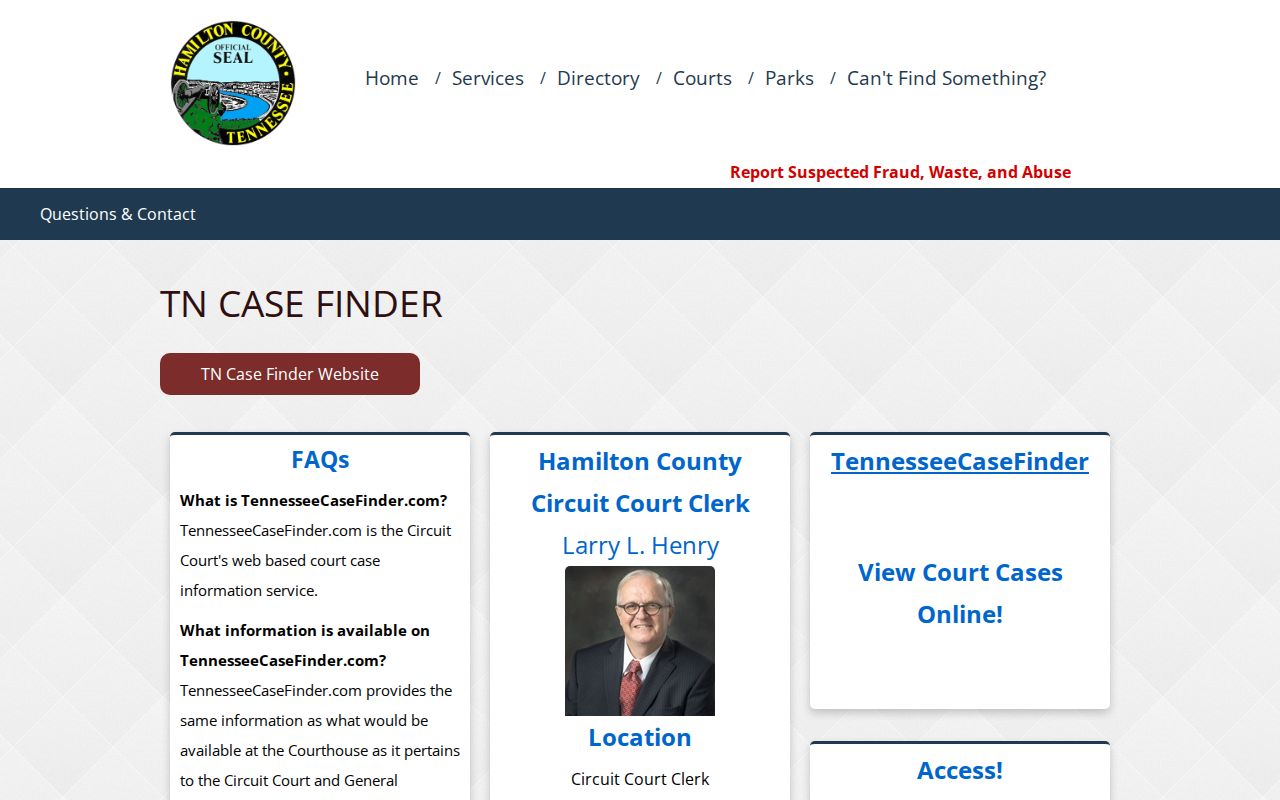
Use the Chattanooga court name and a case identifier to verify the right matter before asking the clerk for a permitted record or copy.
Chattanooga City Court is separate. The Chattanooga City records hub points to court records, citations, and dockets, while its City Court search captures a required last name and optional first name, citation, docket, PD case, warrant, plate, state, and VIN fields. Chattanooga citation search is also targeted and uses identifying details. These Chattanooga routes help locate a known matter, not create a general history for a person.
Chattanooga City Court records directs users to the City's court and docket paths.
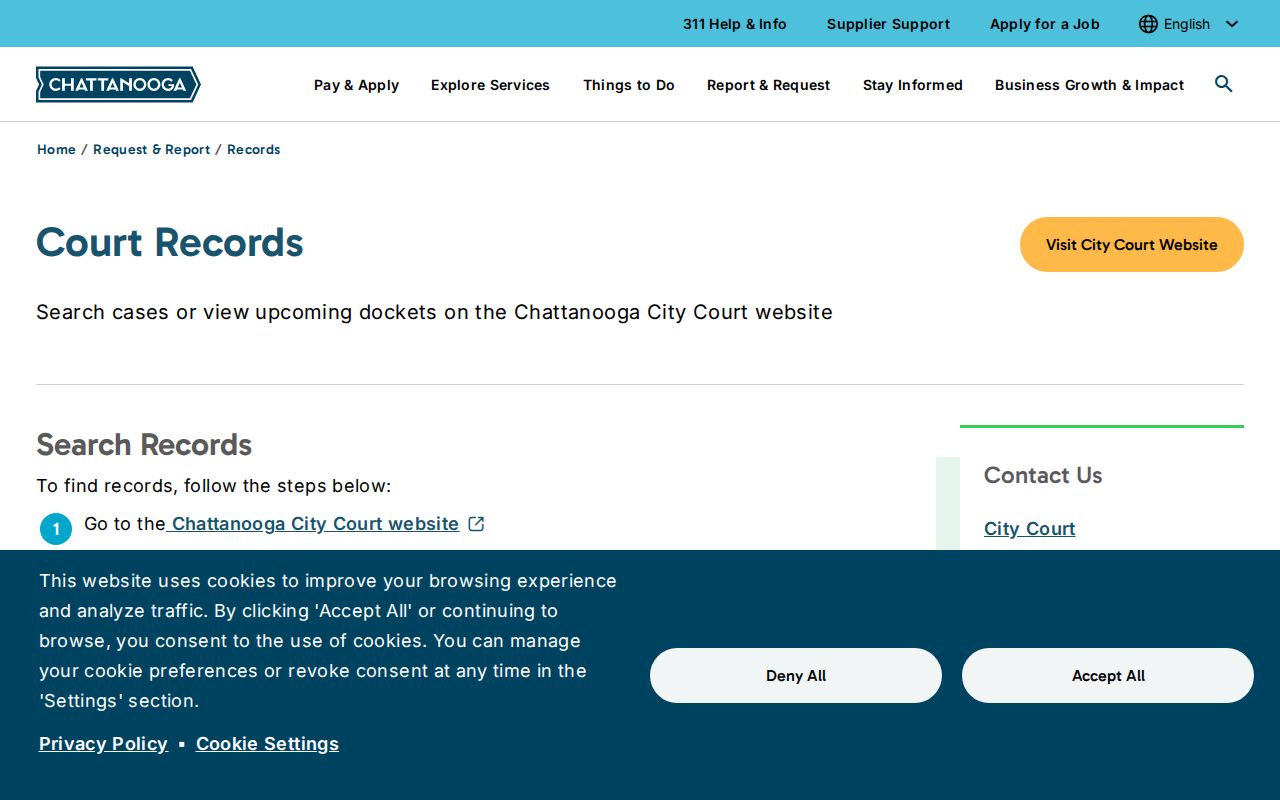
When the Chattanooga city route does not provide the identified record, give the City custodian the case, citation, date, or record description rather than asking for a broad name search.
Chattanooga Voter Lookup Boundaries
Tennessee's Voter Lookup asks for county, first and last name, birth month, and birth year. Hamilton County's individual voter form for Chattanooga voters asks for a last name, last four digits of the Social Security number, and full date of birth. Those Chattanooga identity checks mean neither tool is a browse-by-street directory. Sensitive identifiers should never be entered into unrelated Chattanooga forms or copied into Chattanooga research notes.
The Chattanooga state form shown here is for an individual registration check. It does not establish every Chattanooga address connection, and it is not proof that someone is at a Chattanooga property today.
Tennessee Voter Lookup is the official state interface for the documented individual-search fields.
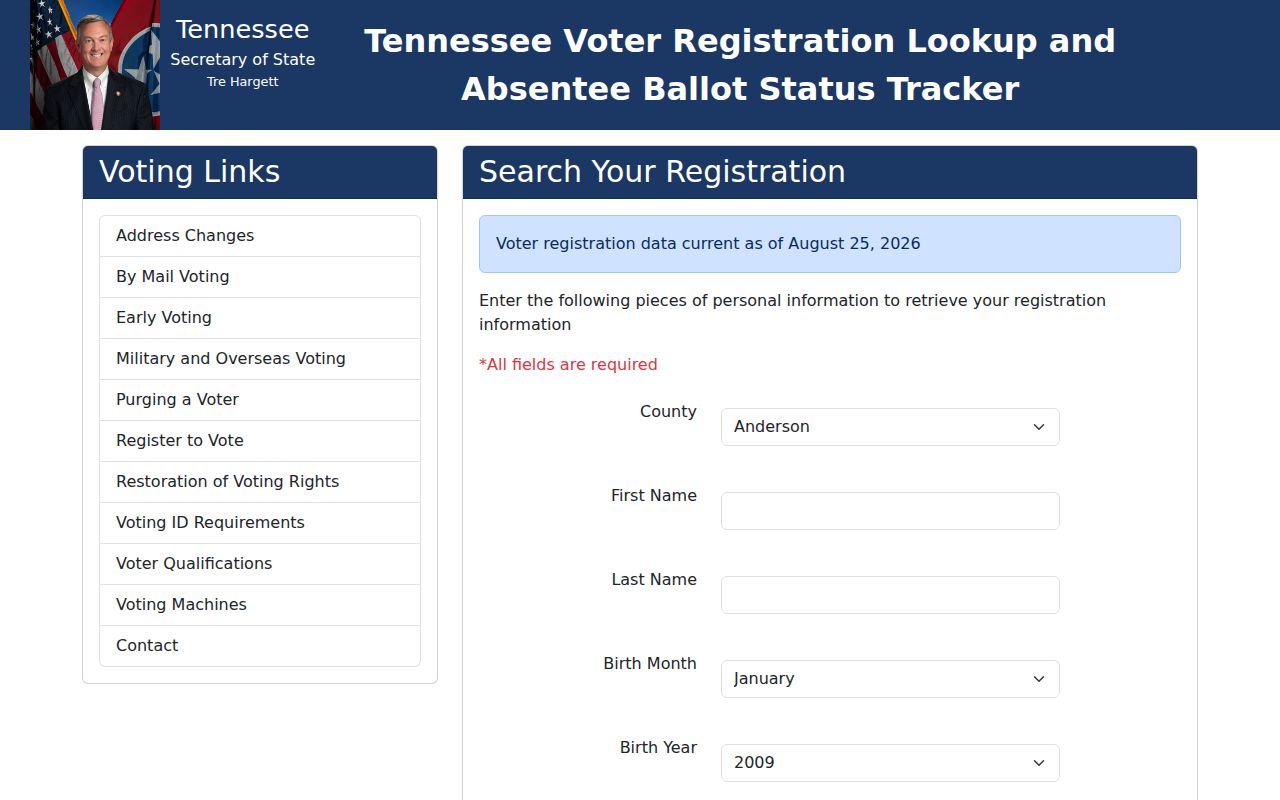
For a defined Chattanooga voter-record request, use the Election Commission's request route and follow its current inspection, copy, citizenship, and redaction rules.
Chattanooga Marriage Index Limits
The Hamilton County Clerk's public Chattanooga marriage search is a useful local identity clue because it states its online run, 1857 through August 3, 2021. Chattanooga search modes include Bride/Groom, Officiant, Marriage Date, Last Names, First Names, and Cross Match. A later Chattanooga license requires contact with the Clerk. A match can identify an indexed event, but it does not by itself establish a current Chattanooga relationship or address.
| Last Name | Visible public field; use with the chosen search route. |
|---|---|
| First and Middle Name | Visible and mode dependent. |
| Search route | Bride/Groom, officiant, date, names, or cross match. |
| Certificate path | The County Clerk lists $5 plus $1.19 postage; Tennessee Vital Records is a separate state route. |
Tennessee Vital Records requires an applicable signed application for a Chattanooga request, identity documentation or notarization path, payment, and a qualified requester. State law makes birth records in the state registrar's custody public after 100 years, while death, marriage, divorce, and annulment records there open after 50 years. A Chattanooga index, an old microfilm record, and a certified certificate have different access rules.
Chattanooga Obituary Lookup Clues
The Chattanooga Public Library's Obituary Index covers 1873 to the present and is updated annually. It gives a name, publication date, and newspaper. That makes it a precise Chattanooga locator for historical research, not a copy of the notice. The Chattanooga source microfilm is held in Local History & Genealogy, and the department can provide copies for a fee on request.
Before 2025, spouse or partner information was recorded only for women in the Chattanooga index. That field pattern is a Chattanooga indexing limitation, not evidence about a family. Use the date and newspaper to find the underlying Chattanooga item, then compare it with a directory, released census, probate file, or other source that has its own date and access rules. For earlier Chattanooga address research, the library's Chattanooga city directory collections provide the dated household layer.
Verify a Chattanooga Resident Record
Use a defined Chattanooga sequence when a name and local address appear to connect. Start with the Chattanooga Assessor's owner search, which accepts a single Last First owner field, a street name, a street number, or a parcel. Compare the corresponding Chattanooga Trustee view before moving to a recorded document. The Chattanooga Register's account-only system offers Party, Book & Page, Document, Property, Party/Property, Index, and Quick searches; party mode defaults to July 1, 1969 forward.
- Record the Chattanooga address, parcel or map reference, and spelling shown by the Assessor.
- Compare the Chattanooga Trustee's property and mailing fields without treating the mailing field as proof of residence.
- Use a known book and page, property, party, or Quick Search with the Chattanooga Register account or counter to check a recorded role.
- For a Chattanooga historical question, compare a dated directory entry, obituary citation, or released census record before drawing a conclusion.
- Docket
- A court's tracking record for a case, with events and identifiers set by that court.
- Index and image
- An index helps locate a record; an image is the underlying document or scan and may have separate access rules.
- Certified copy
- A custodian-issued copy bearing the certification required for an official purpose, not merely an online search result.
Chattanooga Register instructions say an entry marked “SEE MICROFILM” is not electronic. The Chattanooga counter, a microfilm copy, phone, email, or a detailed Tennessee Public Records Act request is the next route when an online screen stops.
Chattanooga Registry Search Caution
Chattanooga custody, court, and registry sources answer different questions. The TBI Sex Offender Registry is an official registry with its own disclaimer and search controls, including name or alias, address, city, county, ZIP, offender ID, status, and offense. It warns that information originates with local registering agencies and can change, a limit Chattanooga users should keep in mind. It is not part of a routine resident lookup or a way to identify a Chattanooga household.
The Chattanooga registry screen below requires acceptance of its notice. Follow that Chattanooga notice, report a factual error through its stated process, and never use a result to threaten, intimidate, stalk, or harass anyone.
TBI Registry Search provides the official disclosure-controlled interface.
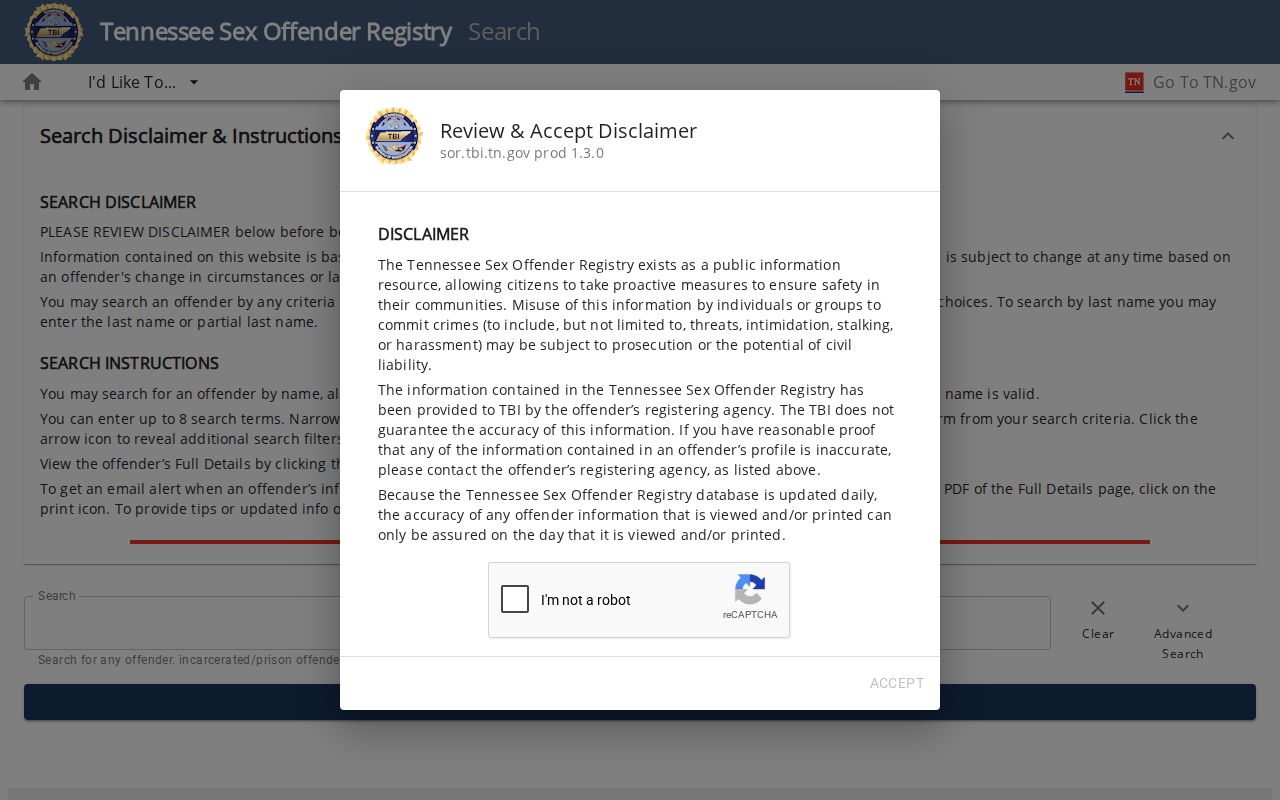
A Chattanooga non-match or a match in any one system does not settle a person's identity, address, or legal status.
Chattanooga Records Request Fallback
When an identified Chattanooga record is not online, ask the Chattanooga custodian for that record rather than for a compiled report about a person. The Tennessee Public Records Act, Tenn. Code Ann. §§ 10-7-501 et seq., gives Tennessee citizens an inspection right under § 10-7-503 unless another law restricts the material. A Chattanooga request should state the record type, name or address, date range, known case or parcel number, and whether inspection or copies are wanted.
The Chattanooga City Open Records Center accepts city requests. The Chattanooga Register allows inspection-only requests without its written form and may require an estimate or prepayment for copies or electronic material. Under the state framework for Chattanooga requests, a custodian that cannot promptly provide a record must, within seven business days, provide it, deny it with a legal basis, or explain the time needed. That response rule does not require an office to create a new Chattanooga resident index.
Chattanooga Open Records guidance shows the City's official request route.
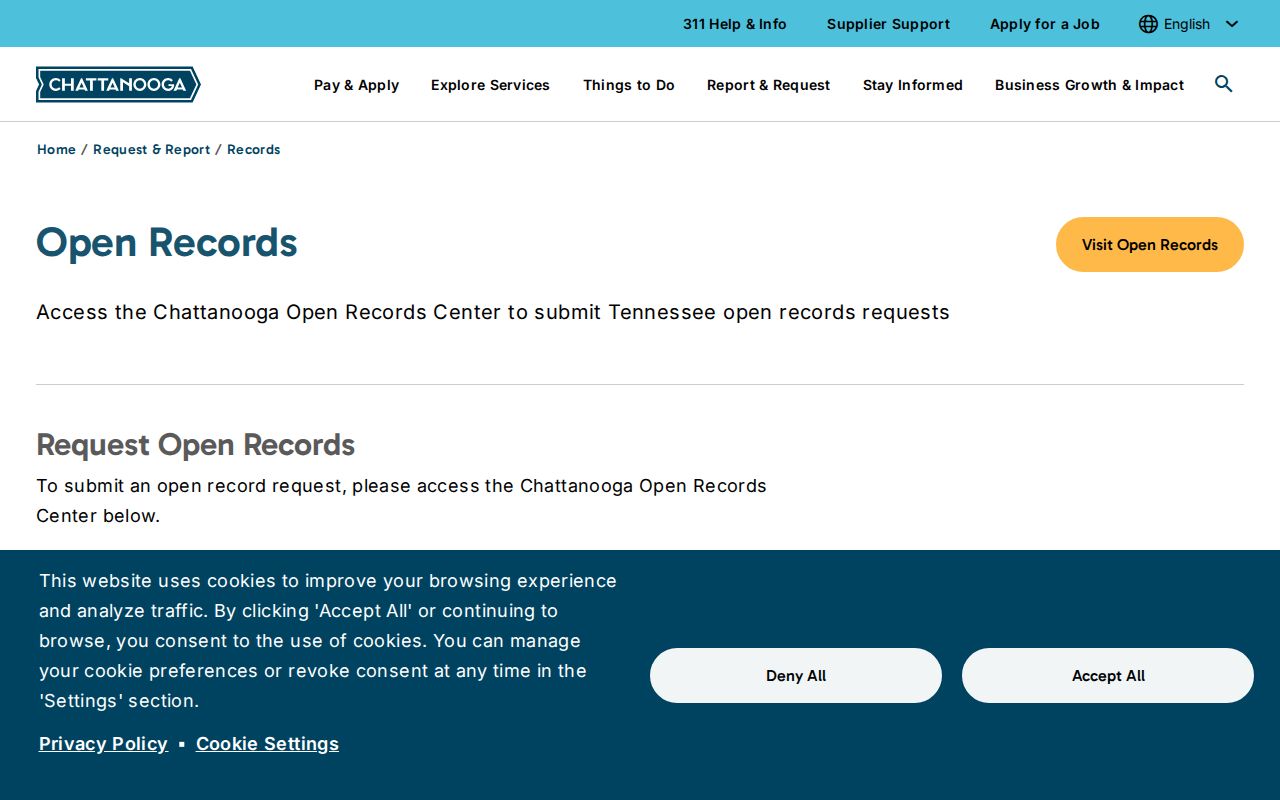
Use the Chattanooga portal for a defined city record, then retain the request date and any response from the Chattanooga custodian.
Lawful Chattanooga Resident Lookup
For Chattanooga users, Tennessee Safe at Home supplies a substitute address for eligible survivors under Tenn. Code Ann. §§ 40-38-601 et seq. It does not erase existing Chattanooga records, and its substitute address has real-property and tax exceptions. Chattanooga court files may also be sealed, expunged, juvenile, adoption-related, or otherwise restricted. Absence from a Chattanooga search screen is not proof that no record exists.
Correct a Chattanooga error with the record custodian. The Chattanooga Assessor handles incorrect property mailing information, the Chattanooga Register handles recorded-instrument correction processes, and a Chattanooga court or registry error belongs with its own office. Tennessee's Information Protection Act governs qualifying private controllers and does not erase lawful county or Chattanooga city records. Keep Chattanooga requests narrow, save the response, and do not assemble unrelated public details to expose a protected person.
Lawful use. Chattanooga resident lookup records are for personal, lawful research. Never use them to stalk, harass, intimidate, impersonate, or harm another person.