
Finding Chattanooga Residents
Chattanooga records do not form one master list of people. The Hamilton County Assessor ties an owner name or property address to a parcel. The Register of Deeds follows parties to recorded instruments. Chattanooga library directories place a listed person at an address for one edition, while court and marriage indexes answer narrower questions. Each Chattanooga source has a different custodian and date range. A Chattanooga property result can establish an owner or mailing connection, but it does not establish every person who lives in a building. A historical Chattanooga directory entry also belongs to its publication date, not to the present.
For a current Chattanooga question, preserve the exact spelling, address format, and search date. For a past Chattanooga address, retain the street number, directional prefix, suffix, and community label. That detail makes it easier to compare a Chattanooga parcel record with a later deed, a directory line, or a newspaper locator. The order below starts with the least restricted local sources and leaves a focused request for material that is not posted online.
- Search the Hamilton County Assessor by owner, street, number, or parcel to establish the Chattanooga property record.
- Compare the parcel and any sale reference with a recorded-instrument search at the Hamilton County Register.
- Use Tennessee’s individual voter route only to check a registration question, never as a Chattanooga street browse.
- For a historical Chattanooga household, check nearby city-directory editions and the library’s newspaper indexes.
- When a needed Chattanooga record is not online, ask the correct custodian for a defined record type, subject, date range, and inspection or copy format.
Chattanooga Resident Records Offices
Three Chattanooga-area offices provide the clearest starting points for the residents directory trail. The Chattanooga Register is the custodian for recorded instruments. The Assessor maintains the property roll and parcel search. The Election Commission handles registration questions and voter-record procedures. Chattanooga City offices hold their own administrative and court material, so a City request is not a substitute for a Hamilton County land-record search. The Chattanooga cards list the particular office rather than treating all Chattanooga records as though they share one counter.
Hamilton County Register of Deeds
625 Georgia Avenue, Room 400
Chattanooga, TN 37402
423-209-6560
Hamilton County Assessor of Property
6135 Heritage Park Drive, Bonny Oaks
Chattanooga, TN 37416
423-209-7300
Hamilton County Election Commission
700 River Terminal Road
Chattanooga, TN 37406
423-209-VOTE (8683)
Chattanooga Assessor Search Fields
The free Hamilton County Assessor search is the most direct Chattanooga property starting point. One complete field is required. For Chattanooga searches, Street Name can return a whole road, Street Number narrows a street result, Parcel accepts the county’s documented spacing and decimal formats, and Owner accepts last name first in one field. In Chattanooga, a partial surname expands the result set. Chattanooga users should narrow broad street text because embedded strings can match, and should remember that a later-listed joint owner may not appear in the owner index.
| Chattanooga Assessor field | How it works |
|---|---|
| Street Name | Enter a street name; a street-only query can return a street-wide set. |
| Street Number | Pair it with the street name to target an address. |
| Parcel | Use the county’s exact spaces and decimal notation. |
| Owner | Enter last name first; partial entries are allowed. |
The Hamilton County Assessor Property Search shows the four-field Chattanooga entry screen.
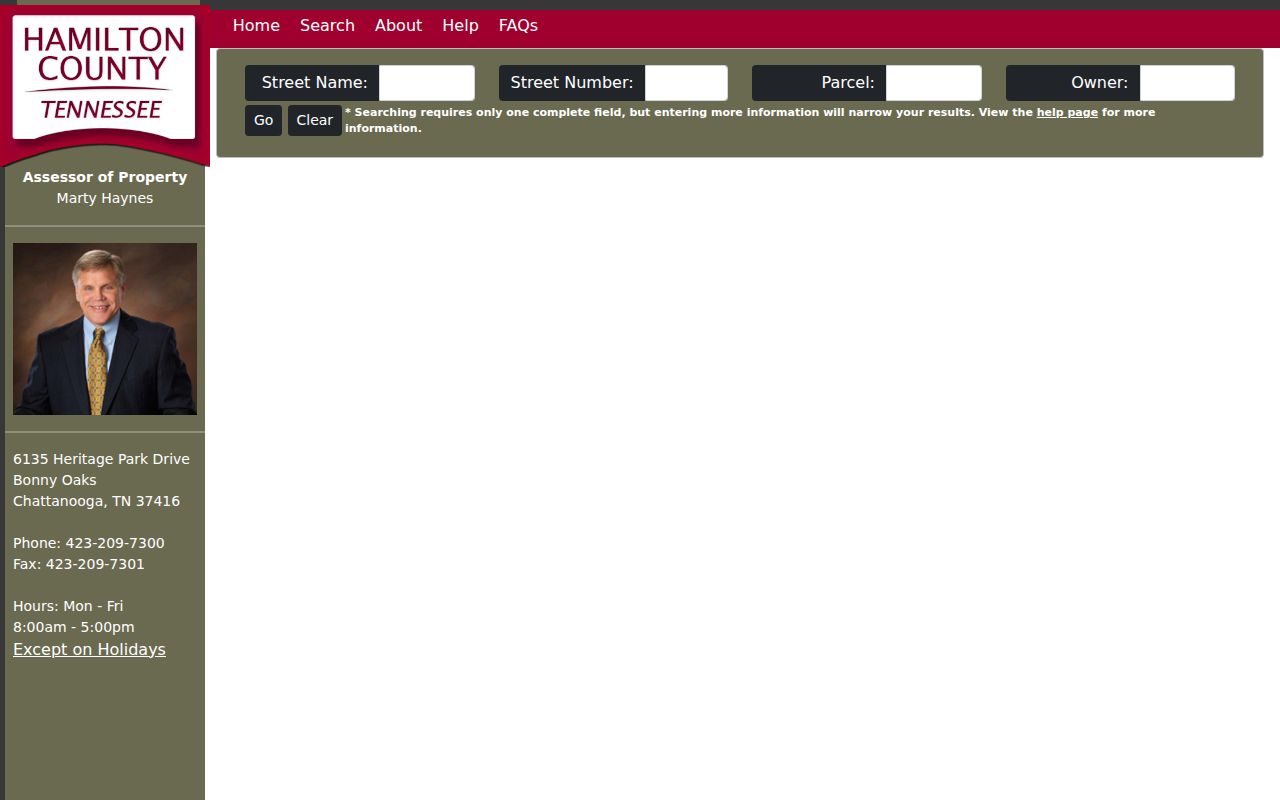
Use a Chattanooga result as an assessment record, then verify recorded ownership with the Register when that distinction matters.
Chattanooga Parcel-to-Deed Trail
A Chattanooga parcel trail connects sources with separate roles. The Chattanooga Assessor and Trustee can provide parcel, map-group, property-address, owner, and mailing-address context. The Register supplies the recorded-instrument path, including book and page references, parties, and legal descriptions. The property or situs address identifies the assessed location. A mailing address is where correspondence goes. Neither field says who occupies the place. Chattanooga research is stronger when those meanings stay separate instead of being flattened into a single address line.
In Chattanooga, take a book and page from assessor sales information to the Register’s Book & Page search, or use the Register’s Property, Party/Property, or Quick search after account access. Quick Search begins a title-chain workflow from Assessor sales information, but the Register does not perform or warrant title searches. For a street-by-street Chattanooga property workflow, the Chattanooga street directory keeps the address angle separate from a name-led search.
- Parcel
- A county assessment unit linked to land and improvements.
- Situs address
- The physical property address carried in the assessment record.
- Mailing address
- An owner correspondence address that may differ from the property.
- Book and page
- A recorded-instrument reference used to locate a document in the Register system.
Note: Hamilton County assessment maps support assessment work and are not conclusive evidence of legal ownership or a survey boundary.
Chattanooga Register Access Choices
The Hamilton County Register’s Chattanooga database is useful but not an anonymous free index. In Chattanooga, electronic access requires an application and a $50 monthly account. The official instructions document Party, Book & Page, Document, Property, Party/Property, Index, and Quick modes. Party search requires a date range and defaults to July 1, 1969 through the present. A result can link by book and page to a PDF or TIFF image for account holders. “SEE MICROFILM” marks material that is not electronic and may require a microfilm copy or help at the Chattanooga counter.
| Chattanooga route | Best use | Access |
|---|---|---|
| Assessor search | Parcel and property-roll context | Free public search |
| Register account | Instrument modes and Quick Search chain | Application and monthly account |
| Register counter or request | Inspection, copies, and microfilm follow-up | Office policy and request detail apply |
The Hamilton County Register Property Alert is a separate Chattanooga protection tool. It accepts voluntary name or address monitoring after signup.
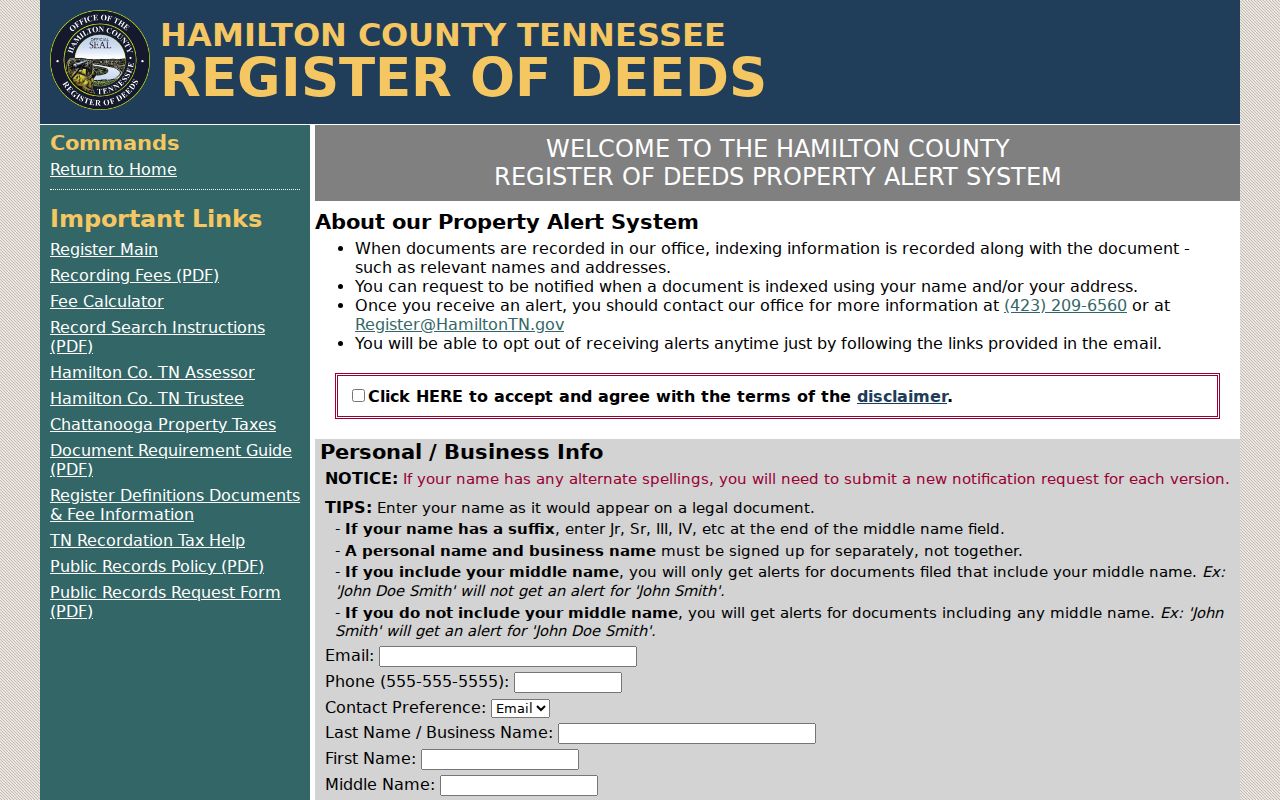
Property Alert notices begin after enrollment and do not replace a Chattanooga document search or a review of recorded instruments.
Chattanooga Voter Lookup Limits
Chattanooga voter information has a narrower purpose than a residents directory. Tennessee’s Voter Lookup asks for county, first name, last name, birth month, and birth year. Hamilton County’s own form requires a last name, the last four digits of a Social Security number, and full date of birth. For Chattanooga use, those identity checks make the tools unsuitable for browsing an apartment, block, or street. Chattanooga registration information is also time-sensitive: maintenance, moves, death notices, and other statutory processes can change a record.
| Chattanooga voter route | Documented inputs or limit |
|---|---|
| Tennessee Voter Lookup | County, first name, last name, birth month, and birth year. |
| Hamilton voter form | Last name, last four SSN digits, and full date of birth. |
| Voter-list order | A separate certified request process with political-use requirements. |
The Tennessee Voter Lookup capture shows the state’s Chattanooga-area individual registration fields.
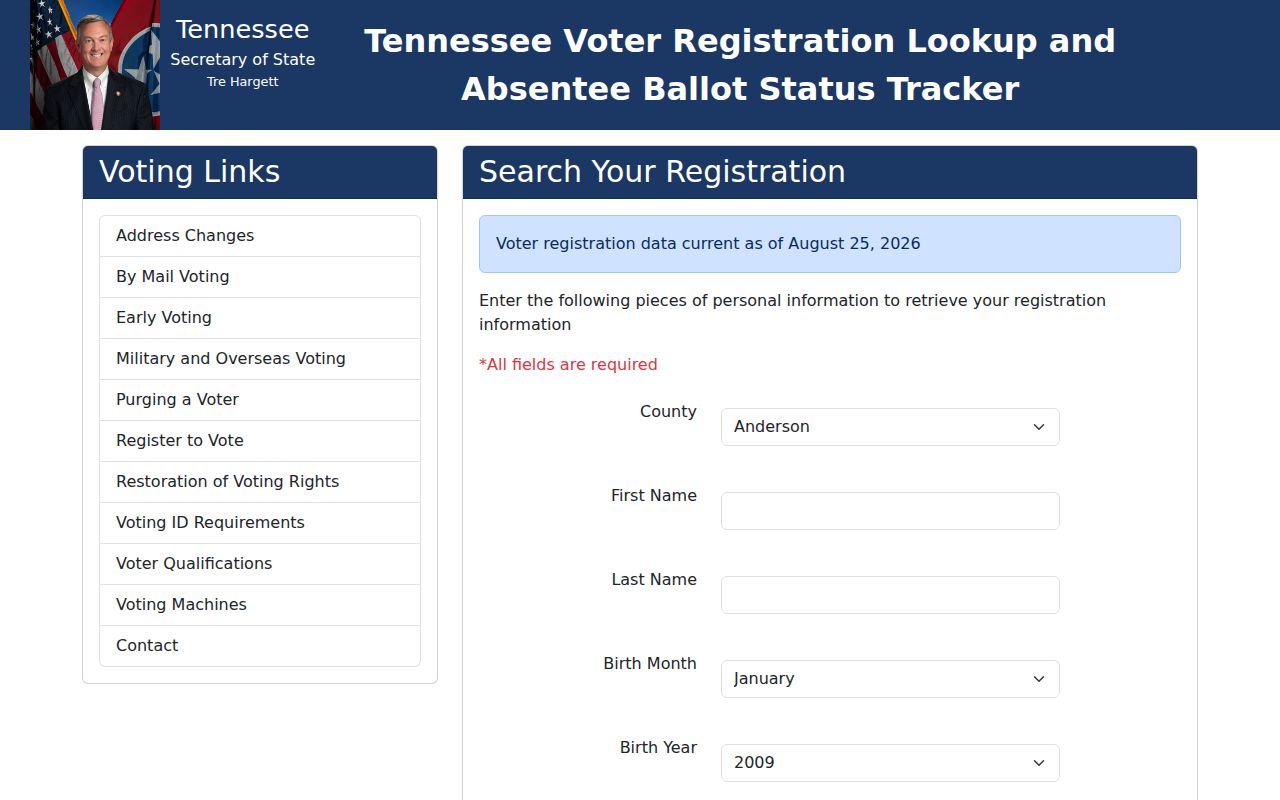
Never enter sensitive identifiers into unrelated Chattanooga search forms or treat a missing result as proof that a person has no connection to the area.
Chattanooga Court Search Boundaries
Chattanooga court indexes are another records path, not a general household list. Tennessee CaseFinder is the official inquiry service for Hamilton County Circuit Court and General Sessions Civil Court. For Chattanooga matters, its landing material identifies party-name, file-date, and attorney-name searches; the county describes it as free, though a signup and login are required. Chattanooga City Court remains separate. The City records hub routes city cases, dockets, citations, and violations through its own channels, while Chancery, Criminal, Juvenile, and federal matters belong to other custodians.
The Tennessee CaseFinder landing page identifies the Chattanooga Circuit and Sessions Civil route.
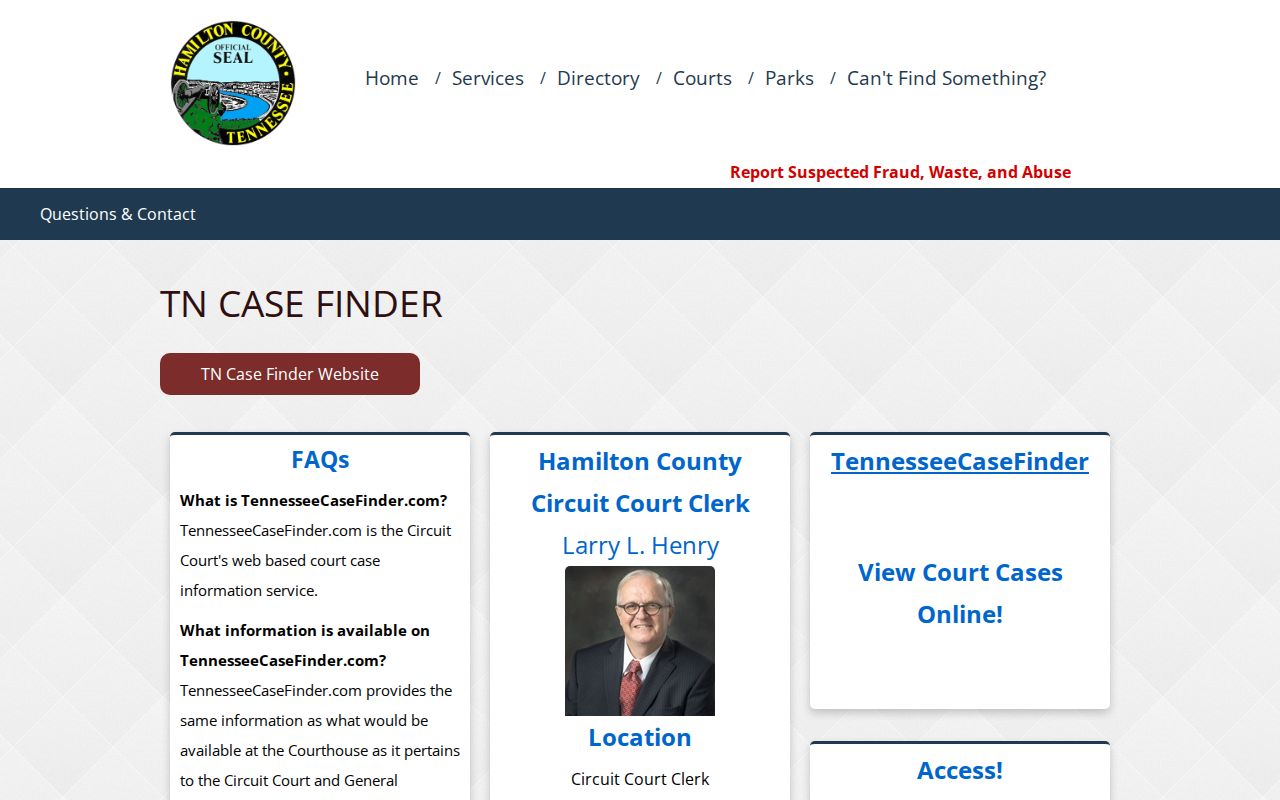
For a Chattanooga file, verify the court division and ask its clerk about copies, docket access, sealing, expunction, or other restrictions.
Chattanooga Public Index Boundaries
Some Chattanooga sources locate a record without answering a residence question. The Chattanooga Obituary Index covers newspaper obituaries from 1873 to the present and returns a name, publication date, and newspaper. For Chattanooga research, it is a locator, not the obituary text. The source microfilm is held in Chattanooga Local History & Genealogy, where a copy may be requested. That distinction matters when a Chattanooga family-history search reaches a name but needs the underlying newspaper before it can confirm the event or relationship.
Specialized public sources have even tighter limits. The Tennessee Bureau of Investigation registry search is the official registry entry point and has its own notice-controlled use rules. It is not a Chattanooga resident-verification method, and a result must never be used to threaten, harass, or infer a household. The official registry remains the proper place to check the current notice and search controls.
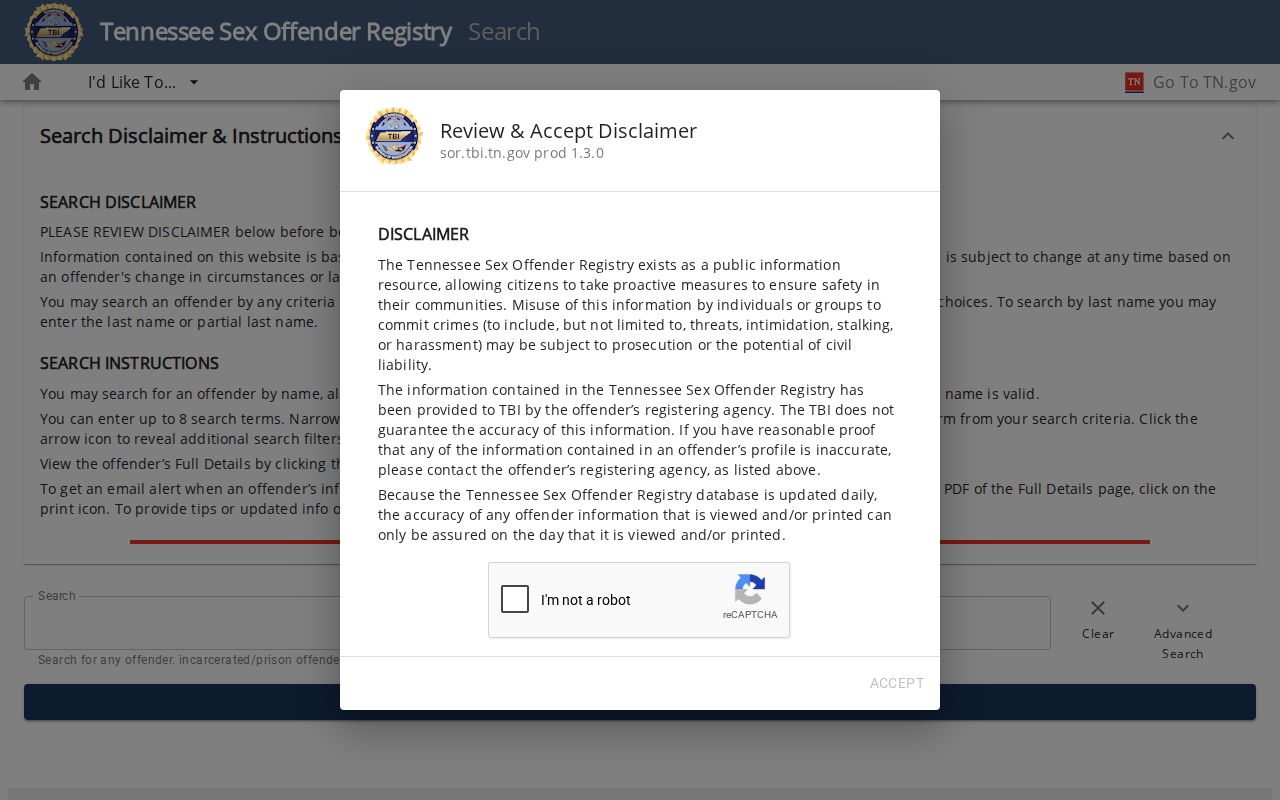
The Chattanooga screenshot documents the official entry screen, not a conclusion about any person or an invitation to combine unrelated records.
Current Chattanooga Resident Directories
Current Chattanooga directory-like sources each describe a limited connection. The Assessor and Trustee identify property and tax-record context. The Register indexes recorded parties. Individual voter tools serve registration questions. City records can locate an administrative file when a defined subject and date range are supplied. The Chattanooga neighborhood-association map is civic orientation, not a membership roll: its public data carry names, status, and map links for 104 active association features, while boundaries are informational. Chattanooga residents directory research is most accurate when the source is matched to the precise question.
| Chattanooga source | Connection shown | Custodian | Access path |
|---|---|---|---|
| Assessment roll | Parcel, owner-indexed property record, value details | County Assessor | Free search or counter |
| Tax roll and bill | Parcel, tax status, situs and mailing fields | County Trustee | Inquiry, downloads, or counter |
| Recorded instruments | Recorded parties and document path | County Register | Account, counter, or request |
| City records | Defined city or police record | City custodian | Open Records Center request |
| Neighborhood map | Civic association map context | City Neighborhood Services | Public map and staff route |
A Chattanooga name match needs another Chattanooga record with a compatible date, address, or document reference before it becomes a reliable identification.
Chattanooga Marriage Record Split
Hamilton County’s marriage-license search and Tennessee certificates answer different Chattanooga questions. The County Clerk’s public License Search covers 1857 through August 3, 2021 and supports Bride/Groom, Officiant, Marriage Date, last-name, first-name, and cross-match routes. Later Chattanooga licenses require contact with the Clerk. For Chattanooga users, a state certificate is separate. Tennessee Vital Records applies its own eligibility, identification, form, and fee rules, so an index hit does not give every requester a right to a certified copy.
The Hamilton County Marriage License Search is the Chattanooga-area index route. For older Chattanooga research, Tennessee law makes birth records open after 100 years and death, marriage, divorce, and annulment records open after 50 years, subject to the cited statutory rules and archival access. Keep a license-index search, a certificate request, and a court file as three different record types.
Chattanooga Requests Beyond the Portal
When a Chattanooga online search stops, identify the custodian before asking for more. The Tennessee Public Records Act, Tenn. Code Ann. §§ 10-7-501 et seq., governs the general state framework, including the inspection right in § 10-7-503 for Tennessee citizens unless an exception applies. A request should state the record type, relevant name or address, date range, and whether inspection or copies are wanted. Custodians need not create a new compilation. If material cannot be provided promptly, the response framework calls for the record, a denial with legal basis, or a written time estimate within seven business days.
The Chattanooga Open Records guidance directs City requests through the Open Records Center and explains the City’s request channels.
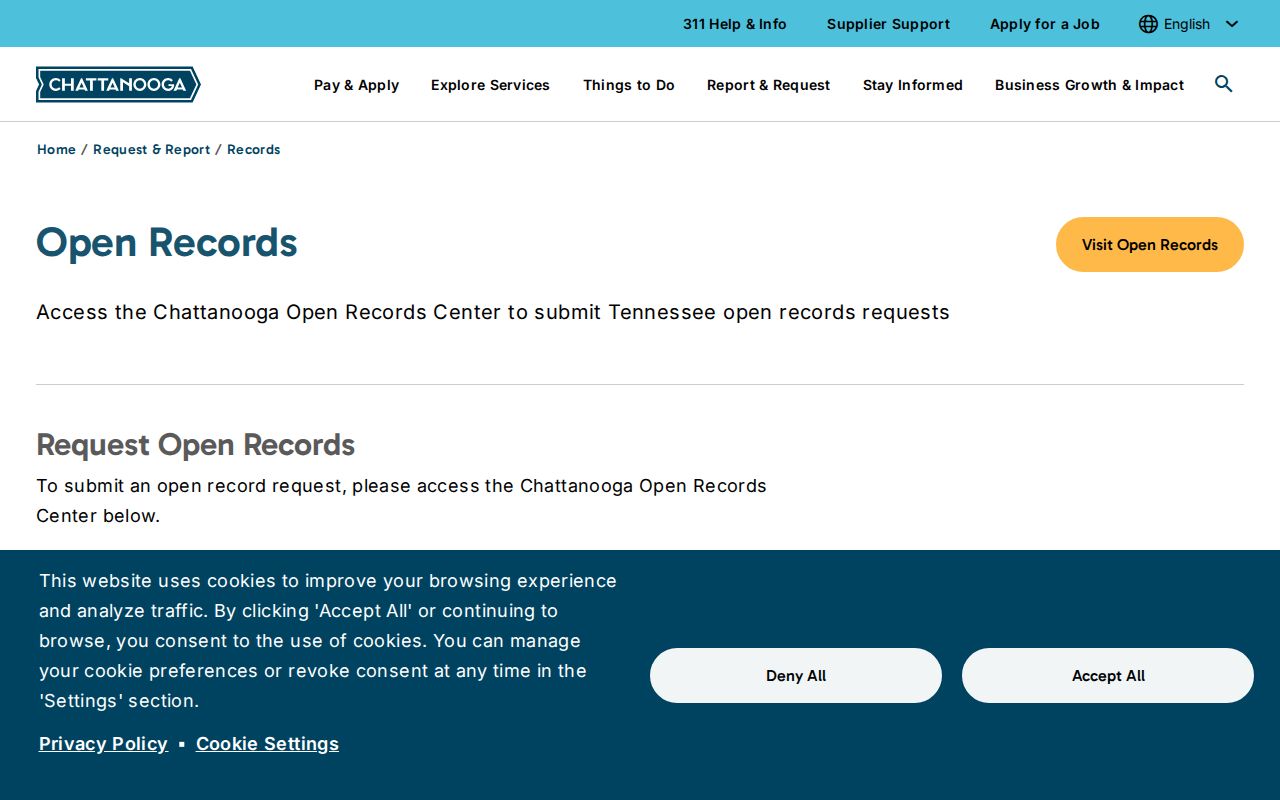
For Chattanooga Register material, inspection at the counter, phone, email, mail, or a detailed form may be available; microfilm follow-up is needed when the system says a record is not electronic.
Historical Chattanooga Resident Directories
Chattanooga Public Library’s Local History & Genealogy Department is the core historical shelf for a residents directory search. Its Chattanooga city-directory run spans 1871 to 2008, with gaps in 1873 through 1875, 1877, and 1879. Volumes before 1938 are on microfilm. A digitized 1871 to 1960 run is available through Ancestry Library Edition at Chattanooga Public Library branches. The department also holds maps, plats, newspapers, county records, manuscripts, and a searchable obituary index, so a Chattanooga address can be checked against more than one kind of evidence.
A printed directory may give a listed name and address for a particular edition. It cannot by itself establish title, current residence, or a continuous household. The full collection treatment belongs in the Chattanooga city directory, while a quick Chattanooga search can start at Chattanooga Public Library Local History & Genealogy. Ask staff about non-circulating reference material, microfilm, or scans and photocopies; the department can identify sources but does not undertake in-depth research for patrons.
Note: The 2025 Chattanooga History Collections change redirected researchers from PastPerfect Online to finding aids, digital collections, and archivist assistance.
Chattanooga Address Names Through Time
Chattanooga historical search labels can change even when a parcel or family connection continues. In 1929, Chattanooga annexed St. Elmo, Missionary Ridge, Alton Park, North Chattanooga, Brainerd, and Riverview, doubling the city’s size. An older Chattanooga directory, permit, newspaper, or map may therefore use a locality label that differs from a modern postal identity. The city’s river, rail, and industrial history also appears across street photographs, business records, maps, and neighborhood files. Use the historic label as a search term rather than assuming every record was filed under today’s city wording.
For a Chattanooga house-history question, pair a date-specific directory listing with an Assessor parcel, a Register instrument, and, when available, a plat or Sanborn sheet. The Library guide points to plats from 1889, 1904, 1914, and 1928, plus local Sanborn holdings. Map dates describe the map, not universal construction or occupancy dates. Chattanooga postal labels and city limits are also different geographies, so check jurisdiction before sending a city request. Preserve the query date and document reference because the Assessor’s downloadable records refresh on a 30-day cycle.